What the Binance Hack Reveals About Authorization Risk in Enterprise Virtual Assets
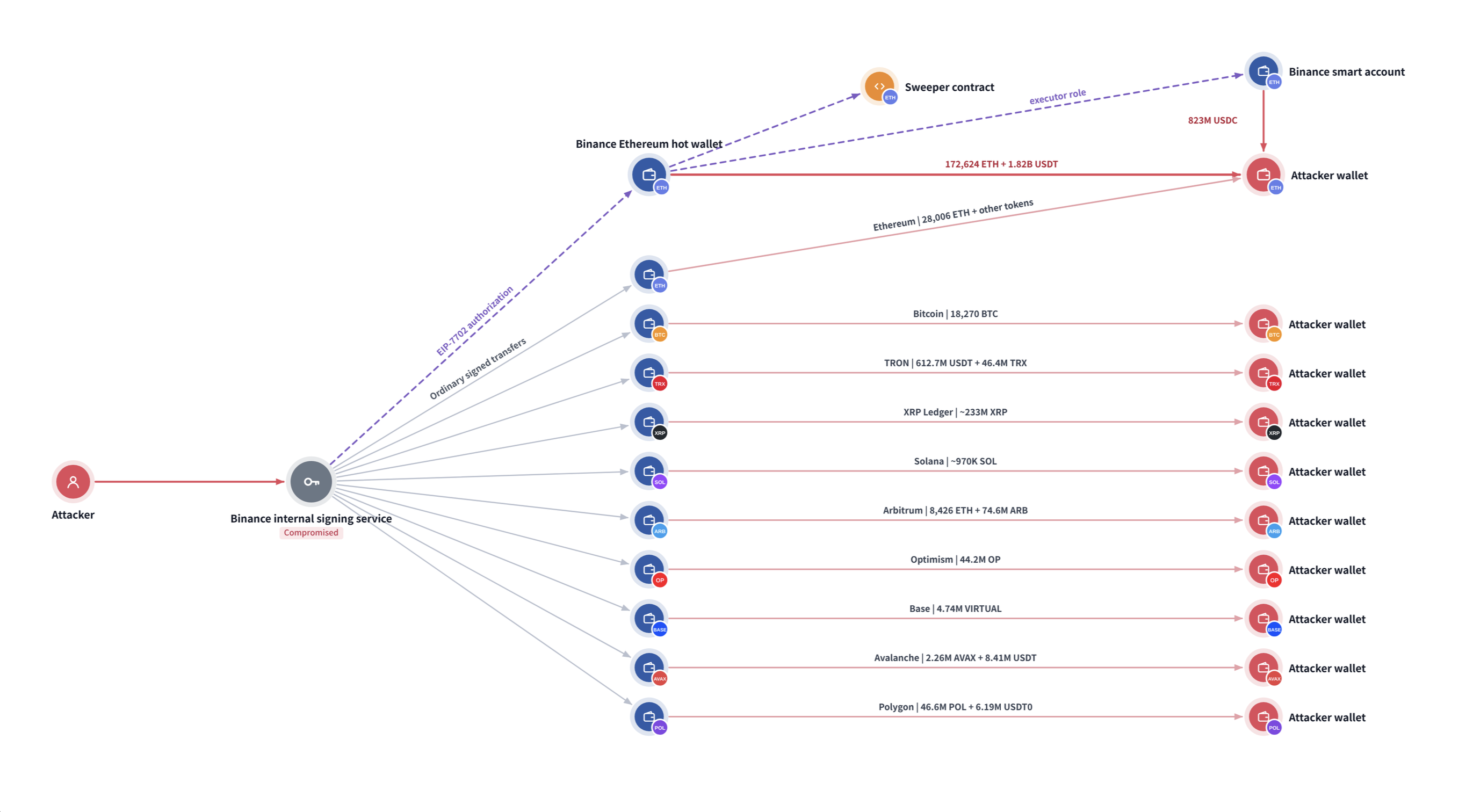
In the early hours of October 30, 2026, global cryptocurrency exchange Binance suffered a major security incident: hot wallets across multiple blockchains were hit by unauthorized asset transfers. According to Binance's latest preliminary investigation, the incident affected approximately USD 6.34Billion digital assets. As of November3, roughly US2.85 billion had been frozen or intercepted.
The incident has put exchange asset security in the spotlight. It also raises a question every organization should revisit:
If a transaction carries a valid signature, does that mean the organization actually authorized it?
For banks, exchanges, and other institutions that manage virtual assets, protecting private keys is essential. But ensuring that every signed transaction matches what the organization actually intended is an equally important part of asset security.
One Authorization Can Keep Assets Exposed to Ongoing Risk
One technique that has drawn attention in this attack is Ethereum's EIP-7702.
EIP-7702 allows an account to delegate part of its execution authority to a smart contract without handing over its private key. According to Binance's preliminary investigation, after gaining unauthorized access to an internal wallet transaction-signing service, the attacker used this mechanism to give attacker-controlled smart contracts partial execution authority over Binance's hot wallets.
Binance further stated that the attacker submitted 50 signed transactions to manage the accounts' transaction sequence numbers (nonces) and establish malicious delegations. Once in place, these delegations could keep executing independently of the original withdrawal system. As a result, pausing withdrawals or shutting down hot wallet services would not automatically invalidate delegations already recorded on-chain; they had to be revoked separately through on-chain transactions.
Pangolink's on-chain analysis likewise observed that, along the attack path on Ethereum, validly signed authorizations allowed the hot wallets to execute code deployed by the attacker, while other affected wallets showed signed transactions of a standard form.
This means the risk of a signature can't be judged only by how much was transferred out at that moment.
Some operations change what a wallet is permitted to do. Even if no large transfer happens right away, they can still affect asset security down the line.
A Secure Private Key Doesn't Guarantee a Safe Transaction
In its October 30 announcement, early in the incident, Binance stated that it had found no evidence that wallet private keys had been leaked. The preliminary investigation released on November 3 went further: the attacker had gained unauthorized access to an internal wallet transaction-signing service and launched operations outside the normal withdrawal process.
The latest findings show this was not as simple as a single compromised computer. The attack chain spanned multiple stages, including social engineering, malware, the exploitation of devices and credentials, and the compromise of internal tools. Ultimately, the attacker used a compromised engineer's device and its associated privileges to deploy malicious code, which in turn affected wallet signing operations. Binance also emphasized that these are preliminary findings and will be subject to an independent security review.
This points to something that is easy to overlook:
Even if a private key is never stolen, a system can still sign transactions the organization never intended.
Even when private keys are protected by HSMs, MPC, or other security mechanisms, organizations still need to verify what requests the signing system accepts, who submitted them, what approvals they went through, and whether the final signed content matches the operation that was originally approved.
In other words, organizations need to protect not just the private key itself, but the entire transaction request, approval, and signing process that sits in front of it.
How Can Organizations Reduce Similar Risks?
This incident is a reminder that as virtual asset operations grow more diverse, traditional security measures focused only on private key custody and transfer amounts may no longer cover every risk.
The growing use of smart contracts, account delegation, and automated transactions also means organizations must take a closer look at how they manage transaction authorization and signing.
1. Before signing, look beyond the amount to what is being authorized
A standard transfer, a token allowance approval, and a delegation of account execution rights each carry a different level of risk.
An operation that doesn't immediately move a large amount of assets can still change what the wallet is allowed to do afterward. So before signing, beyond confirming the amount and the recipient address, you also need to understand whether the operation involves a permission change and what impact it could have once it takes effect.
If you can't clearly identify what an authorization does, confirm its purpose first, then decide whether to sign.
2. Make sure the executed transaction matches what was approved
An organization's transaction workflow typically moves through request, review, signing, and submission.
Organizations need consistency checks that run from the transaction request all the way to execution, ensuring that what actually reaches the signing system, and what is finally submitted on-chain, matches the transaction that was originally approved.
The core risk of so-called "blind signing" is that approvers can't fully verify what they are actually signing. Security controls therefore can't stop at confirming that someone approved a transaction. They also need to confirm:
Whether what the approver saw, what the signing system actually signed, and the transaction finally executed are all consistent.
3. Keep managing authorizations after they take effect
A completed transaction doesn't mean all the risk is over.
In this incident, Binance explicitly noted that pausing withdrawals and shutting down hot wallet services would not automatically invalidate EIP-7702 delegations already on-chain. Those authorizations had to be revoked through separate transactions.
Beyond monitoring for unusual transfers, organizations therefore also need visibility into each wallet's current authorization status, and whether any permissions are no longer needed or look abnormal.
When an anomaly is detected, pausing withdrawals isn't enough. Organizations should also review the related authorizations, affected wallets, and automated fund-transfer workflows at the same time to keep the risk from spreading.
From Protecting Private Keys to End-to-End Risk Management
The Binance hack shows once again that virtual asset security is about more than keeping private keys safe.
As smart contracts, account delegation, and automated transactions become more widespread, organizations need to manage not only who holds the private keys, but also how transactions are requested, how they are approved, and what ultimately gets signed and executed on-chain.
Every stage, from transaction request and approval to signing and on-chain execution, should fall under risk controls, with checks that the final executed transaction matches the original authorization.
M-Key Secure Vault from BlockChain Security (BCS) uses risk control rules, threshold-based approval management, and an independent transaction review mechanism to give institutions an extra layer of verification and review before any transaction is executed, reducing the risks of transaction mismatches and blind signing.
At its core, M-Key uses security technologies such as TEE (Trusted Execution Environment) and IMA (Integrity Measurement Architecture) to strengthen protection of the signing environment and execution integrity. This reduces the risk that a compromised high-privilege environment could go on to affect private keys and the signing process.
Learn more about M-Key Secure Vault: https://blockchainsecurity.asia/en/products/m-key