Cross-Border Transfers Need More Than On-Chain Records: How the Travel Rule Connects VASPs Worldwide
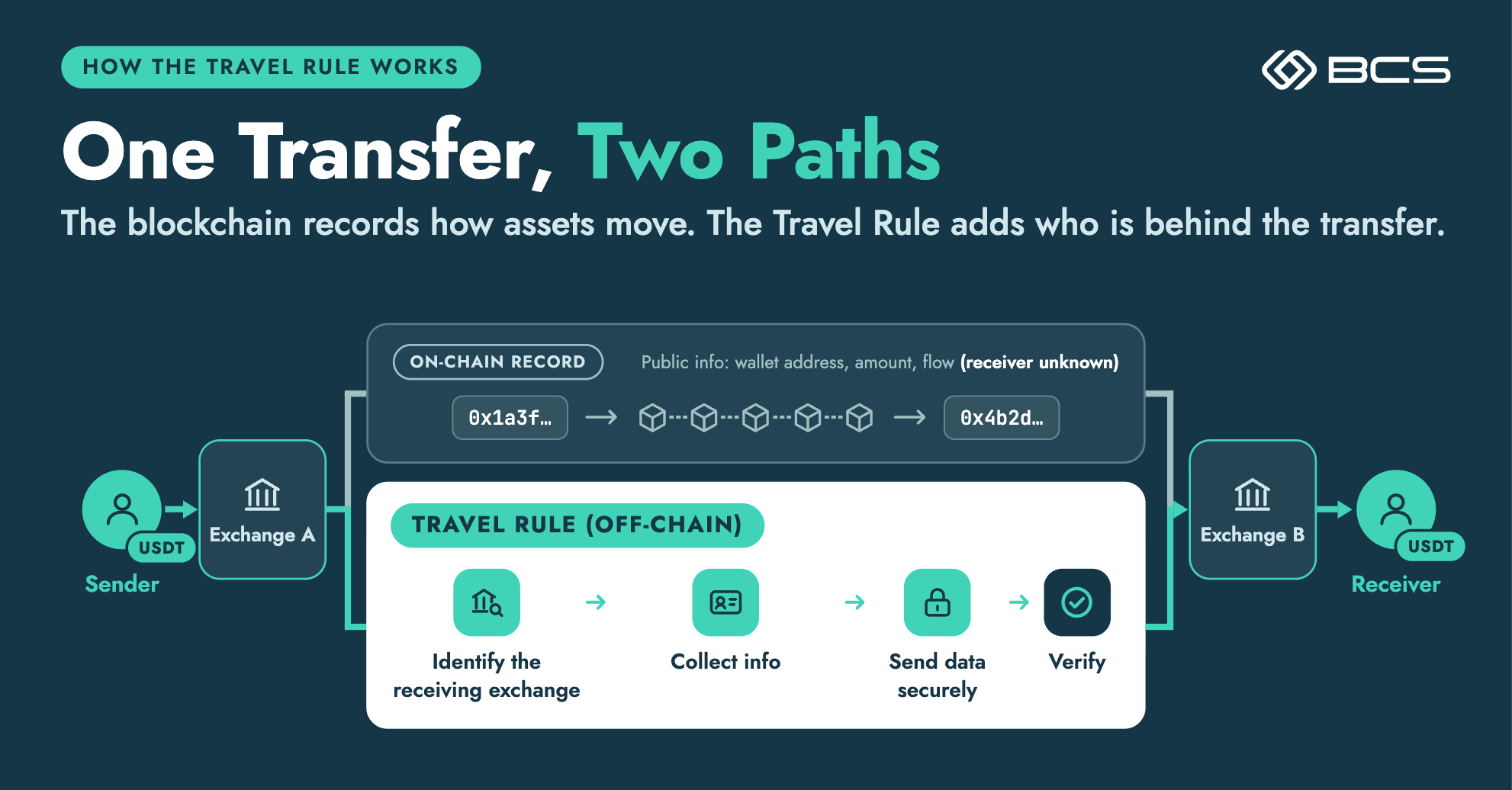
When USDT moves from an exchange in Taiwan to a platform overseas, the blockchain records where the assets went, how much was sent and which wallet addresses were involved. What it cannot directly confirm is which institution sits behind the receiving address, or who the actual recipient is.
As the Travel Rule is rolled out around the world, financial institutions and virtual asset service providers (VASPs) need to do more than trace the flow of funds. They must also identify their counterparties, exchange identity information, and make their systems work together across borders.
1. The Travel Rule Is More Than Attaching Identity Data
The Travel Rule comes from wire transfer rules in traditional finance, which require financial institutions to obtain and pass on the necessary originator and beneficiary information whenever they transfer funds.
In 2019, the Financial Action Task Force (FATF) extended these requirements to VASPs. In 2025, the FATF revised Recommendation 16 (R.16) to strengthen transparency in cross-border payments, and these requirements also reach VASPs through Recommendation 15.
Unlike a bank wire, a blockchain address does not reveal who holds it. The Travel Rule therefore relies on secure off-chain communication to exchange the necessary information between providers, without writing personal data onto a public blockchain.
Put simply, the blockchain records how assets move, and the Travel Rule supplies the identity information behind the transfer.
2. How Does a Cross-Border Transfer Actually Work?
Suppose a user sends USDT from one exchange to another exchange overseas.
Besides confirming the receiving address, the sending platform needs to identify which VASP is on the receiving end. Under the applicable rules, it must also obtain and transmit the necessary information about the originator and the beneficiary.
The industry already has common data standards such as IVMS101. These let different platforms structure identity information in a consistent format before exchanging it through secure communication channels.
The receiving platform then verifies the data and carries out the compliance checks required under local regulations. If information is missing or something looks irregular, the transfer may need further review, or may be put on hold or rejected.
None of this requires changes to the underlying blockchain. The real challenge is whether providers around the world can exchange information smoothly.
3. Three Challenges to Global Interoperability
First: Counterparty identification (VASP Discovery)
A wallet address alone does not always show whether it belongs to an exchange, a custodian or a self-hosted wallet managed by the user. To identify counterparties more accurately, providers need to combine address intelligence, institutional directories and counterparty confirmation mechanisms.
Second: Protocol interoperability
Platforms may use different communication protocols or service networks, such as TRP, TRUST, Sygna Bridge and GTR. Even when they share the IVMS101 data format, their systems cannot necessarily connect directly. Enabling different solutions to exchange information securely is a key technical challenge for cross-border compliance.
Third: Regulatory gaps (the Sunrise Issue)
Countries are implementing the Travel Rule on different timelines and with different requirements. When the sending provider is already regulated but the receiving provider’s market has not yet introduced the same obligations, the information exchange may be incomplete.
Even where both jurisdictions have passed legislation, differences in enforcement can still slow down cross-border transactions.
4. Legislation Is Accelerating, but Implementation Still Lags
According to a FATF report published in July 2026, 91 of the 109 jurisdictions surveyed (83%) have passed Travel Rule legislation, up from 73% in 2025.
However, 55 of those 91 jurisdictions (60%) have yet to take any supervisory or enforcement action on Travel Rule compliance.
This shows that while rules are taking shape worldwide, supervision and enforcement are still catching up.
The EU, Japan and the UK have already implemented the Travel Rule, but the conditions that apply still differ from market to market. For example, the FATF allows simplified verification for certain occasional transfers below USD/EUR 1,000, whereas the EU in principle sets no general threshold exemption for in-scope crypto-asset transfers.
Taiwan is also introducing the Travel Rule in phases. On 20 October 2026, Taiwan’s Financial Supervisory Commission (FSC) issued amended regulations, and the Travel Rule now applies to transfers between domestic VASPs. Transfers between domestic and overseas VASPs are expected to be covered by the end of 2027, subject to official announcements by the regulator.
Under the amended rules, the Travel Rule applies regardless of the transfer amount. For transfers above NT$30,000, providers must obtain additional identity information and apply enhanced verification.
The period between the domestic rollout and the extension to cross-border transfers is an important window for Taiwanese providers to build international interoperability.
5. How On-Chain Analytics and the Travel Rule Complement Each Other
At its core, the Travel Rule is about exchanging the necessary identity information. Before that exchange can happen, however, a provider first needs to know who its counterparty is likely to be.
This is where on-chain analytics can help.
Using wallet address labels, address attribution analysis and fund-flow tracing, providers can find clues about the exchanges, custodians or self-hosted wallets an address may be linked to, and spot potentially high-risk activity.
Address analysis provides a basis for identification and risk assessment, but on its own it cannot replace confirmation of a counterparty’s identity. Used together, the two make the cross-border compliance process more complete.
As stablecoin payments, virtual asset custody and cross-border settlement continue to grow, VASPs and financial institutions need more than secure data exchange. They also need the ability to identify counterparties, analyse on-chain risk and keep records.
The Travel Rule is evolving from a regulatory requirement into essential infrastructure that connects virtual asset financial services around the world.
BlockChain Security (BCS) continues to invest in on-chain financial intelligence and Travel Rule services, helping financial institutions and VASPs meet global compliance requirements and build a safer, more reliable environment for digital asset transactions.