Vitalik Buterin at ETH Taipei: EIP-8288 and the Move to Off-Chain Proofs
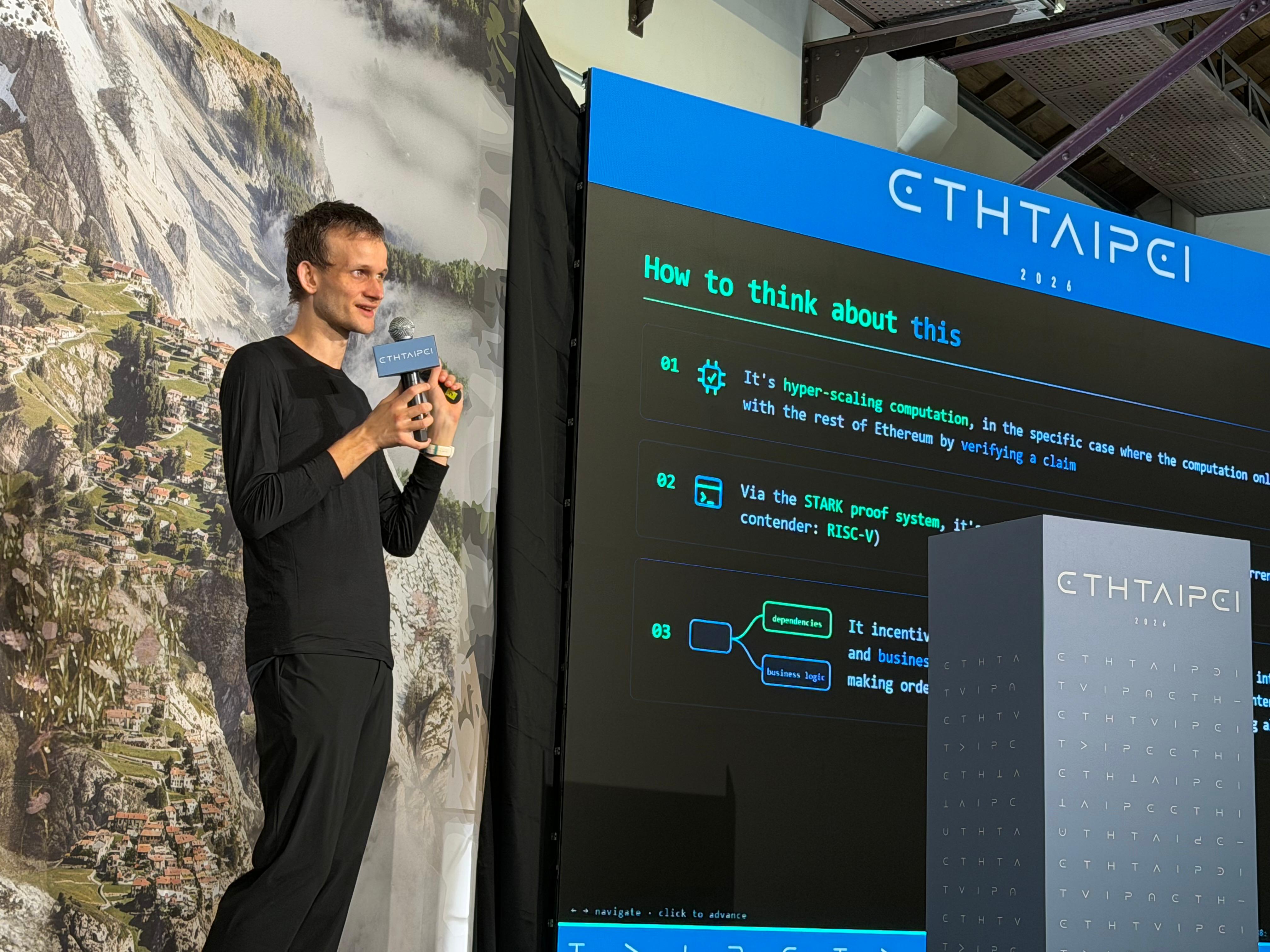
At ETH Taipei, Ethereum co-founder Vitalik Buterin introduced EIP-8288 (In-Mempool Recursive STARK Aggregation), outlining a major structural shift in how Ethereum processes signatures and zero-knowledge proofs.
Currently, advanced cryptographic operations—such as quantum-resistant signatures (like SPHINCS+, Falcon, or ML-DSA) and zero-knowledge privacy proofs—face extreme gas overhead on-chain, with post-quantum transactions estimated to cost up to ~10 million gas. EIP-8288 directly addresses this bottleneck by moving heavy verification off the main execution path.
Key Architectural Shift & Highlights:
Off-Chain Mempool Aggregation: Transactions declare their signatures and STARK proofs as 96-byte "dependency" frames (scheme, data_hash, verification_key_hash). Mempool nodes collect these claims every tick (~500ms) and aggregate them off-chain into recursive STARK proofs.
Single Master Proof per Block: Instead of validators checking every transaction signature individually, block builders package all dependencies into a single STARK master proof (~100–300 kB) per block.
Slashing Gas Costs by >99%: Requiring validators to execute only one master proof check on-chain drops transaction overhead from millions of gas down to the low tens of thousands.
Private Account Abstraction: Decoupling signature checking from the EVM allows wallets to implement custom, private access control mechanisms without increasing base-layer gas costs.
VM Standardisation: The proposal positions RISC-V as a primary virtual machine candidate for recursive STARK transaction proving across Ethereum.
Blockchain Security & Forensic Impact:
From a Blockchain Security (BCS) and digital forensics perspective, EIP-8288 introduces zero compromise to consensus integrity. Because STARK proofs rely on mathematical soundness, offloading execution to the mempool significantly reduces validator DoS attack vectors without requiring trust in off-chain nodes—an invalid signature simply yields an unprovable master proof.
Additionally, this architectural shift directly impacts crypto tracing platforms like PangoLink. As EVM execution offloads individual transaction signatures into off-chain mempools, security and forensic tools must evolve beyond basic on-chain gas tracking to support off-chain Data Availability (DA) layers and recursive proof verification. Integrations with scalable protocols ensure platforms like PangoLink maintain seamless end-to-end visibility over fund flows, anti-money laundering (AML) compliance, and multi-hop tracing across Ethereum's evolving ecosystem.